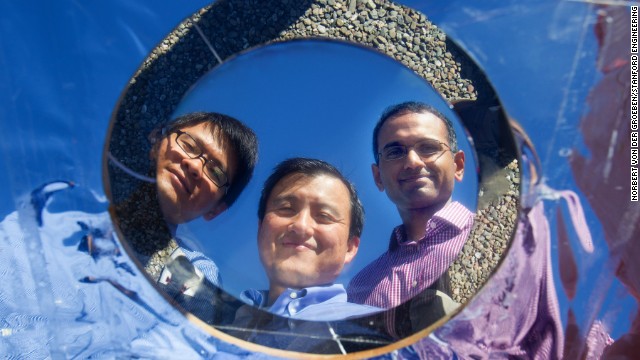
Shanhui Fan, center, and grad students Linxiano Zhu, left, and Aaswath Raman show off their invention.
So much for old-fashioned air conditioning: What if you could harness the universe to cool your house?
Some Stanford University engineers may have figured out how to do just that.
According to a paper in the scientific journal Nature, a team led by Stanford electrical engineer Shanhui Fan has come up with a material that can radiate heat away from buildings and send it directly into space.
The wafer-thin material -- just 1.8 microns thick, about 50 times thinner than a piece of paper -- is made up of layers of silicon dioxide and hafnium oxide on top of a layer of silver. It both acts as a mirror, reflecting sunlight back into space, and channels invisible, heat-bearing infrared rays away from the source and into the universe.
"Think about it like having a window into space," Fan told the Stanford Report.
he Stanford team calls it "photonic radiative cooling," and if the material is applied to surfaces such as rooftops, it could help lower the need for air conditioning. In tests, the material was capable of cooling a surface by 5 degrees Celsius (about 9 degrees Fahrenheit).
"This team has shown how to passively cool structures by simply radiating heat into the cold darkness of space," Nobel Prize-winning physicist Burton Richter, a Stanford professor emeritus, told the Stanford Report.
What makes it intriguing, team member Aaswath Raman told CNN, was the material's ability to radiate heat in daylight.
"What's special is not that it radiates to space -- most materials exposed to the sky already do that, and can thus do this kind of cooling at night already," he wrote in an e-mail. "It's enabling this effect during the day that's hard, and that's because when you're exposed to the sky during the day the sun will heat you up. So what's new is the combination of being extremely reflective (meaning you absorb almost no sunlight) and radiating to space at the same time. This allows you to get the same cooling effect (to below air temperature) during the day, that you can normally only get at night."
The scientists note that air conditioning currently accounts for about 15% of energy usage in buildings. Moreover, in rural and undeveloped areas, the material could provide a cooling technology that doesn't require electricity.
"Across the developing world, photonic radiative cooling makes off-grid cooling a possibility in rural regions, in addition to meeting skyrocketing demand for air conditioning in urban areas," Raman told the Stanford Report.
There are still obstacles, of course. The team believes production of the material can be ramped up into rooftop-appropriate sizes, but right now it exists only as a relatively small prototype. Moreover, the researchers are uncertain how to conduct heat from a building's interior to the material so it can be sent into space.
But the scientists are optimistic. After all, the universe is vast and very, very cold: about 3 degrees above absolute zero, to be precise. Radiating our heat directly into space could help solve a number of problems on Earth, Fan told the Stanford Report.
"Every object that produces heat has to dump that heat into a heat sink," he said. "What we've done is to create a way that should allow us to use the coldness of the universe as a heat sink during the day."
So much for old-fashioned air conditioning: What if you could harness the universe to cool your house?
Some Stanford University engineers may have figured out how to do just that.
According to a paper in the scientific journal Nature, a team led by Stanford electrical engineer Shanhui Fan has come up with a material that can radiate heat away from buildings and send it directly into space.
The wafer-thin material -- just 1.8 microns thick, about 50 times thinner than a piece of paper -- is made up of layers of silicon dioxide and hafnium oxide on top of a layer of silver. It both acts as a mirror, reflecting sunlight back into space, and channels invisible, heat-bearing infrared rays away from the source and into the universe.
"Think about it like having a window into space," Fan told the Stanford Report.
he Stanford team calls it "photonic radiative cooling," and if the material is applied to surfaces such as rooftops, it could help lower the need for air conditioning. In tests, the material was capable of cooling a surface by 5 degrees Celsius (about 9 degrees Fahrenheit).
"This team has shown how to passively cool structures by simply radiating heat into the cold darkness of space," Nobel Prize-winning physicist Burton Richter, a Stanford professor emeritus, told the Stanford Report.
What makes it intriguing, team member Aaswath Raman told CNN, was the material's ability to radiate heat in daylight.
"What's special is not that it radiates to space -- most materials exposed to the sky already do that, and can thus do this kind of cooling at night already," he wrote in an e-mail. "It's enabling this effect during the day that's hard, and that's because when you're exposed to the sky during the day the sun will heat you up. So what's new is the combination of being extremely reflective (meaning you absorb almost no sunlight) and radiating to space at the same time. This allows you to get the same cooling effect (to below air temperature) during the day, that you can normally only get at night."
The scientists note that air conditioning currently accounts for about 15% of energy usage in buildings. Moreover, in rural and undeveloped areas, the material could provide a cooling technology that doesn't require electricity.
"Across the developing world, photonic radiative cooling makes off-grid cooling a possibility in rural regions, in addition to meeting skyrocketing demand for air conditioning in urban areas," Raman told the Stanford Report.
There are still obstacles, of course. The team believes production of the material can be ramped up into rooftop-appropriate sizes, but right now it exists only as a relatively small prototype. Moreover, the researchers are uncertain how to conduct heat from a building's interior to the material so it can be sent into space.
But the scientists are optimistic. After all, the universe is vast and very, very cold: about 3 degrees above absolute zero, to be precise. Radiating our heat directly into space could help solve a number of problems on Earth, Fan told the Stanford Report.
"Every object that produces heat has to dump that heat into a heat sink," he said. "What we've done is to create a way that should allow us to use the coldness of the universe as a heat sink during the day."
No comments:
Post a Comment